Loading...
25 September 2026Irnofic Engineering
Why Insurance Agencies Can't Afford to Skip Automation Anymore: The Real Cost of Not Using Insurance Copilot
Every insurance brokerage today is fighting an invisible battle: client expectations have moved faster than agency operations have. The gap between what clients expect and what a traditional agency can deliver is exactly where Insurance Copilot steps in — and where agencies that skip it start losing ground quietly.
SECTION FOCUS
Introduction
Every insurance brokerage today is fighting the same invisible battle: client expectations have moved faster than agency operations have. Clients want instant WhatsApp replies, same-day quotes, and claims handled without a dozen phone calls — but most agencies are still running on manual data entry, inboxes, and spreadsheets.
The gap between what clients expect and what a traditional agency can deliver is exactly where Insurance Copilot steps in — and exactly where agencies that skip it start losing ground, quietly, deal by deal.
This post looks at the core benefits of running Insurance Copilot, and just as importantly, what tends to happen to agencies that keep operating without this kind of automation.
KEY TAKEAWAY // LEADERSHIP PERSPECTIVE
The Core Reality: The agencies most at risk aren't the ones that already know they're falling behind — they're the ones assuming "we're doing fine" simply because nothing has visibly broken yet.
SECTION FOCUS
The Necessary Benefits
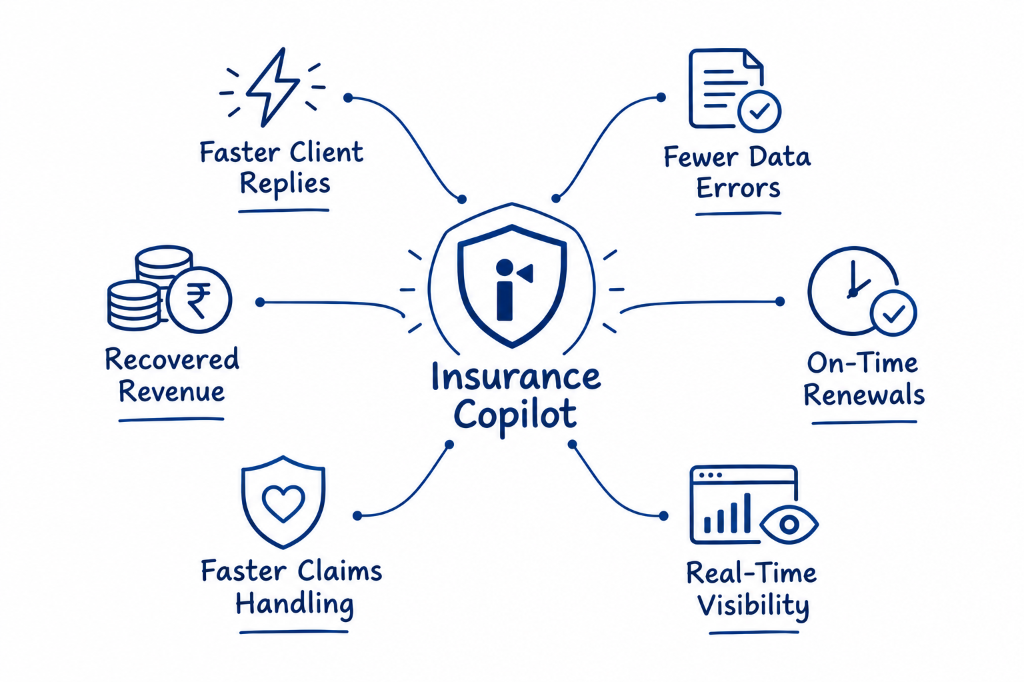
1. You Stop Losing Leads to Response Time
A prospective client messaging at 9 PM on a Friday doesn't wait until Monday morning — they message two other agencies too. Insurance Copilot's WhatsApp AI responds instantly, any hour, any day. The benefit isn't just convenience; it's capturing revenue that would otherwise walk to a faster competitor.
2. You Eliminate Manual Data Entry Errors
ACORD forms are dense and repetitive to transcribe by hand. Every manual re-entry is a chance for a typo that delays a quote, triggers a rejected application, or creates a compliance headache down the line. The ACORD OCR module removes that human error point entirely.
3. You Recover Revenue You're Currently Leaking
Commission reconciliation is one of the most under-scrutinized parts of agency finance. Carriers underpay more often than agencies realize, simply because nobody has time to manually audit every statement line by line. Automated reconciliation surfaces these gaps — money that's rightfully the agency's, sitting unclaimed.
4. You Stop Losing Clients at Renewal
Renewal lapses rarely happen because a client wanted to leave — they happen because nobody called in time. Automated renewal retention tracking closes this gap systematically, rather than depending on an individual agent remembering to follow up amid a busy week.
5. You Handle Claims Faster, Which Builds Trust
The First Notice of Loss (FNOL) moment is when a client needs their insurer most — and it's also when trust is won or lost for the long term. Faster, more accurate FNOL triage means claims move without the delays that erode client confidence.
6. You Get Real Visibility Into Your Own Business
Without a live command-center view, agency owners are often making decisions on stale, fragmented data — a spreadsheet updated last week, a report pulled last month. Real-time portfolio telemetry means leadership always knows exactly where the business stands.
SECTION FOCUS
What Happens If You Don't Use It
The costs of skipping this kind of platform rarely show up as one dramatic failure — they show up as slow, compounding erosion:
- Lost leads become normal, not noticed. Prospects who message after hours simply go elsewhere, and because there's no message to "miss," the agency never even sees the lost opportunity in a report.
- Manual errors quietly cost money and time. A mistyped field on an ACORD form might mean a re-submission, a delayed binder, or a client who now has doubts about the agency's competence.
- Underpaid commissions go unclaimed indefinitely. Without automated reconciliation, most agencies simply never find these discrepancies — the money isn't lost, it's just never collected.
- Renewal churn creeps upward. Agencies without proactive renewal automation typically don't notice the slow bleed until a quarterly report shows retention has dropped — by which point, the clients are already gone.
- Claims handling becomes a client-trust liability. Slow or disorganized FNOL intake is one of the fastest ways to turn a routine claim into a client complaint, a bad review, or a lost policyholder.
- Decision-making stays reactive. Without live telemetry, agency leadership is perpetually working from outdated numbers — reacting to problems a week or a month after they started, instead of catching them in real time.
None of these individually sink an agency. But together, over a year, they compound into a quiet but real competitive disadvantage — smaller margins, slower growth, and client relationships that erode without any single dramatic incident to point to.
SECTION FOCUS
Critical Questions Agency Leadership Must Ask
CRITICAL QUESTION & ANALYSIS
Why does response speed dictate conversion rates in modern insurance?
Over 75% of insurance buyers sign with the first broker to respond with clarity. When an after-hours prospect reaches out on WhatsApp, an instant response powered by WhatsApp AI captures their policy information immediately while competitors remain offline until Monday.
CRITICAL QUESTION & ANALYSIS
How much commission revenue is typically lost to carrier discrepancy?
Studies show between 2% to 6% of carrier commission payouts have discrepancies or missed renewal credits. Automated reconciliation audits carrier payment files against written policies line by line, ensuring every dollar earned is deposited.
CRITICAL QUESTION & ANALYSIS
Why do clients silently churn during policy renewal windows?
Most clients do not churn because of dissatisfaction; they churn because another agency reached them 30 days before expiry with an updated proposal while their existing agent was buried in paperwork. Automated renewal alerts keep your agency ahead of the curve.
CRITICAL QUESTION & ANALYSIS
What is the real opportunity cost of delaying agency automation?
Delaying automation does not keep costs flat — it actively increases customer acquisition and operational expense per policy. While manual agencies spend hours transcribing documents and chasing signatures, automated brokerages operate at higher margins with lower headcount overhead.
SECTION FOCUS
The Bottom Line
The agencies most at risk aren't the ones that already know they're falling behind — they're the ones assuming "we're doing fine" simply because nothing has visibly broken yet.
Insurance Copilot's value isn't just the features it adds; it's the steady, invisible losses it prevents — the leads not missed, the errors not made, the commissions not left on the table, and the renewals not silently lost.
NEXT-GEN AGENCY AUTOMATION
Ready to stop the invisible operational leaks?
See how Insurance Copilot automates WhatsApp policy lookups, ACORD extraction, and renewal alerts for your agency in under 48 hours.